









Reading room
Articles & Ideas
I write about what is changing online and what is worth noticing before someone monetises it. About technology, about advertising that no longer plays fair, and about scams that now look better than the truth.
Sections
- PC & TechnologyWeb, artificial intelligence, cybersecurity
- MarketingSales, advertising, customer relationships, business value
- LifestyleHealth & lifestylecoming
- AchieverThe path to your life goals
- Anti-scamScams, deceptive marketing and fake content — and how to spot themcoming
- Pure GoldPeople and projects I support, and whycoming
Latest pieces
- Why I Built Almost ThereAugust 2026I don't like apps that ask for my attention every single day. Yet I built one — and here is why I made an exception for it.
- How Websites Talk to AI TodayJune 2026More and more people are skipping search engines and asking AI assistants instead. How do you make sure AI understands, cites and recommends you?
- What Should a Website for a Freelancer Actually Cost?June 2026The market is split between two extremes. How do you make sense of prices — and what should you actually get for a fair fee?
- Why a Website Without HTTPS Loses Customers Before They Read a Single WordJune 2026An SSL certificate used to be an extra for banks only. Today, the browser marks you as "Not Secure" and the customer is gone.

The Gallery
Selected work
The new technology so far stands only here — the projects below are classic bespoke architecture and show what I can build and how it looks once people are using it.
This website
annlibertas.eu
Under construction · case study
A house in cross-section instead of a list of services. Each room has its own address and its content is in the HTML from the start — the zoom is camera movement, not a page load. The drawings are photographs of pencil work turned transparent by a script.
React · Vite · předrenderování do statického HTML · AVIF/WebP · Python (Pillow, numpy)
Already working
- The house as navigation, each room with its own address
- Content in the HTML without running JavaScript
- Keyboard control, labels for screen readers
- Three languages
- Drawings from photographs, 35 images in 888 kB
- A moving sky: clouds and sunlight
- Behavioural guidance, tests and all
- Spatial sound: eight sources as points in the house, below you and to the right
- No third-party servers: the fonts are served from here, not from Google
Being built
- Cookie-free analytics
- Butterfly animation
Live projects
Classic bespoke architecture — applications and sites that are running and in use.
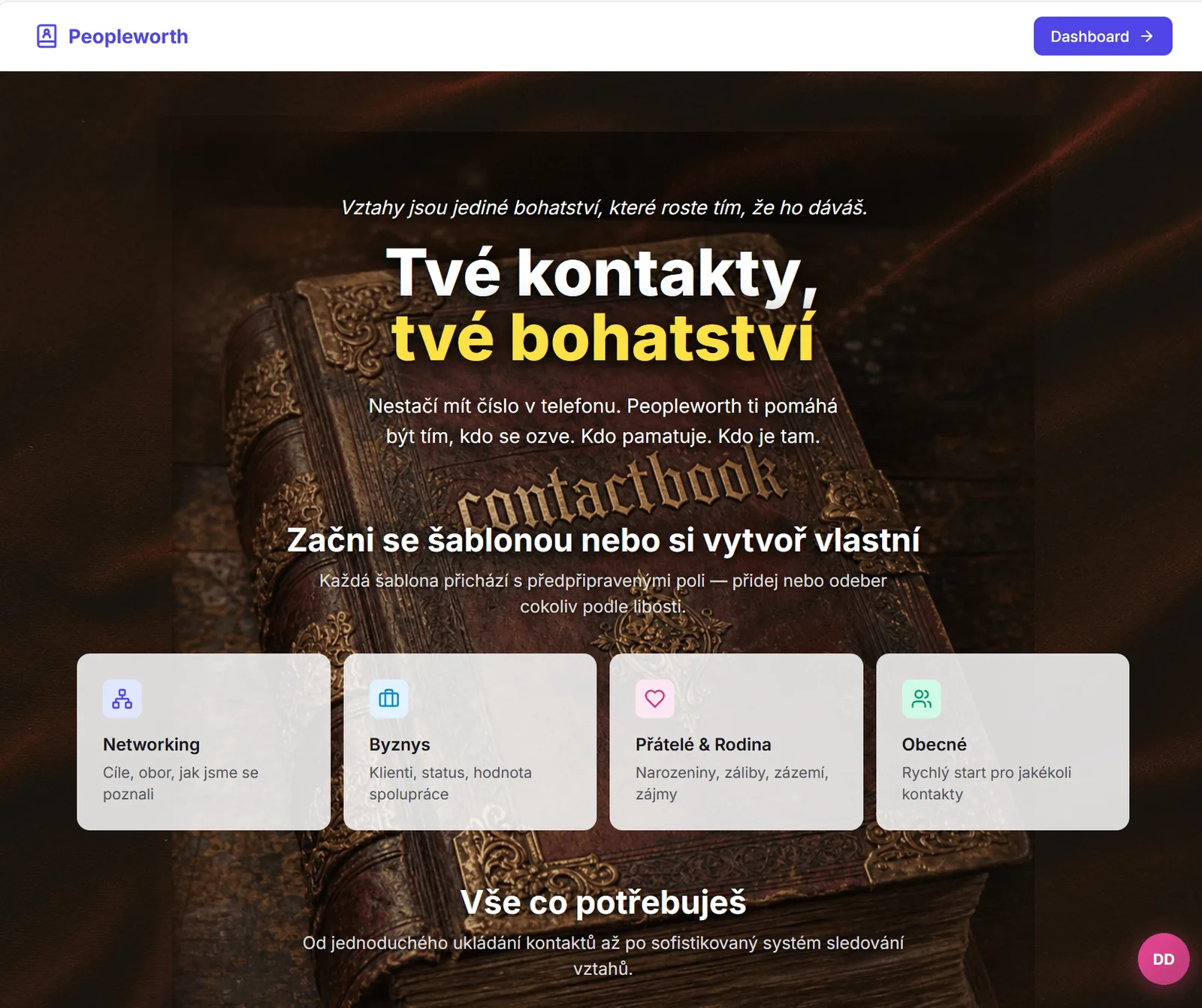
PeopleWorth
A web platform and a mobile PWA. Responsive design, business logic, AI integration. Built in six days.
React · PWA · AI integrace
Almost There
A goal-planning application. You enter a goal and a deadline, and it turns that into a path — phases by month, weeks, and concrete tasks for each day. My own project: planning logic, subscriptions, user accounts.
React · plánovací logika · předplatné · uživatelské účty

Ing. Markéta Horáková
A presentation site for a certified accountant. An overview of services, prices in plain sight, an interactive map and an AI chatbot.
Next.js 16 · TypeScript · Tailwind CSS · Leaflet
Demonstration sites
Sites for invented businesses — they show how differently one technology can look across trades.

Kovinarsko atelje Breznik
A blacksmith studio from Gorenjska. A gallery of hand-forged work, a description of services, a contact form.
Řemeslné studio · galerie · kontaktní formulář

Vinarija Vrh
A family winery in Goriška Brda. A wine catalogue, tasting reservations, a look that reflects the terroir.
Vinařství · rezervace · katalog produktů

Čajna hiša Dolina
A tea house in Ljubljana. Over 150 kinds of tea, tea ceremonies and workshops, a quiet design.
Čajovna · workshopy · minimalistický design

Kovář, Blažek & Partneři
A bilingual site for a Prague law firm. Six practice areas, team profiles, references, news.
Advokátní kancelář · dvojjazyčné · profily týmu
The Concierge
Ask me anything, book a call
There is an assistant at the desk. She knows the offer and the prices, answers a question at two in the morning, and when she does not know something she says so and passes it on — instead of inventing an answer.
She can see when I am free. Not with whom, not what about, not where. The calendar is shared so that the details cannot reach her even if the code gets it wrong.
What she can do
- Answer questions about price, availability, or how a project runs.
- Explain what behavioural guidance or cookie-free analytics actually do, without the marketing gloss.
- Book a consultation — she offers free slots from my calendar and writes a provisional booking.
The booking stays provisional until I confirm it. Until then Google sends you no invitation — you are not a guest in the calendar, only a note in it.
What this means for your site
This is the same thing I build for clients. For a hair salon only the skills change: book a cut, quote a price, send a confirmation. The model is the same, the calendar is yours.
For now she lives on a page of her own. Once she moves in here, she will have a voice too.
The Workshop
Solutions, pricing & tech
The online space is changing right now and there is a chance to be part of that — rather than blending into the mass of “modern” fonts, vibecoded layouts and rocket icons. A lot of those dancing elements are not there for the visitor; they are the developer’s circus act.
The page opens, waits for someone to click, and meanwhile asks permission to track them. There is far more to play with here, and a few things can be done differently.
Interfaces will stop being surfaces to be searched and become places that know someone has walked in. It will be as ordinary as a page fitting a phone is today.
I build sites that know somebody is there — they recognise a visitor who is looking and not finding, and show the way themselves. They measure it without keeping a record of anyone. And they need no consent banner to do it.
What every site gets from me
Built into the site from the start:
- Being findable, in search engines and by AI assistants. The content is in the HTML from the start, not after a script runs, and every page has its own title, description and structured data.
- Accessibility. Usable without a mouse, readable by a screen reader, enough contrast, and nothing important conveyed by colour alone or sound alone.
- Security. HTTPS, security headers, monitored dependencies, input validated on the server, and limits on anything that can be called from outside.
- Speed. Images in current formats and sizes, fonts hosted on your own domain, and nothing running in the background when it is not visible.
- Privacy. Nothing is stored that is not needed. If the site can be built without a consent banner, it is built that way.
- Extensibility. Texts and prices in one place, a new page or language is an added record rather than a new file, and every optional feature has a switch.
- A face of your own. Your branding, not a template you can tell is a template.
If in six months you change your mind about a feature you turned down at the start, the answer will not be “that would mean rebuilding the site”.
Smart additions
They can go in straight away, or at any point later. The base is built to take them, so adding one does not mean building again.
| Addition | What it does |
|---|---|
| An assistant | answers questions around the clock, knows your offer and prices, and hands over to you what it does not know |
| Appointment booking | offers free slots from your calendar and writes a provisional booking; you confirm it |
| Payments | payment gateway, order confirmation, receipts |
| Behavioural guidance | the site notices a visitor is looking and not finding, and quietly points the way — to what they were looking for, never to an order |
| Analytics from the guidance | how many people looked for what, and when it helped; daily totals, no record of an individual visit |
| Sound | a small response to your own click; atmosphere only on request, never by itself |
| More languages | another language is an added record, not a second website |
| Install on a phone | the site can be added to the home screen and opened like an app |
| Hand-drawn elements | the option to have the elements of the site drawn by hand, with the current appetite for the authentic |
Guidance works best where there is somewhere to get lost. On a one-page site it is more of an effect than a help — which is also a reason people order it.
Analytics has two ends. One runs in the visitor’s browser, the other sits on a server receiving the numbers and adding them up. The second one runs all the time, which is why it belongs in the monthly rate.
Starting prices
The website
The base website
40,000 – 80,000 CZK depending on scope
Findability, accessibility, security, speed, privacy and extensibility are part of it — not extras.
Additions
Behavioural guidance
10,000 – 30,000 CZK depending on scope
The site notices a visitor is looking and not finding, and quietly points the way. It only makes sense where there is somewhere to get lost.
Cookie-free analytics
15,000 CZK · 7,000 CZK together with the guidance
Daily totals of what people were looking for and when it helped. No record of an individual visit, and therefore no consent banner. Cheaper together with the guidance because both measure the same things.
Spatial sound
7,000 CZK
A small response to your own click, coming from the side you clicked on. The response is on; atmosphere only on request.
Monthly
Running and managing the server
500 – 1,500 CZK/month depending on complexity
Uptime monitoring, updates, backups with a rehearsed restore, certificates — and a person who fixes it.
A basic site with the guidance comes to 50,000 CZK. With cookie-free analytics on top, 57,000 CZK — together with the guidance it costs 7,000 instead of 15,000, because both measure the same things. The assistant is priced by what you need from it and how far the automation should reach. The monthly fee follows measured token consumption — what actually gets used.
What it is built with
React and Vite, Tailwind for the looks, deployed to Vercel or to your own server. The assistant runs on Anthropic’s Claude models, the calendar through the Google Calendar API, payments through Stripe, mail through EmailJS or Resend.
This site is also the demonstration: the house, the room zoom and the guidance are built from the same things I build for you. The design you get is cut to fit you and what you do.
How we work together
- The brief — what the site has to do, who it is for, what should happen on it. Confirmed in writing, even if it was agreed over the phone.
- The concept — strategy and a description of the implementation, scope, price, deadline. Free.
- A conversation about the concept — by phone, in person, by e-mail or on WhatsApp, whichever suits you.
- The contract.
- The deposit — work starts on the day it is paid.
- Materials from you — texts, photos, logo, access. With a deadline.
- Implementation with ongoing consultation — you see the site as it grows and confirm it matches what you expected.
- Testing before handover — speed, mobile, accessibility, forms.
- Handover and training — half an hour to an hour on a call, and one written page: where everything is, what you can change yourself, who to call.
- Maintenance, if you choose that option.
Step six has a date of its own, because both sides plan around it. Texts and photos are usually what takes longest to arrive, and implementation stops without them. With a day in the schedule, everyone knows when what is coming.
Why you will not get a mock-up up front
It has become common to have a visual mock-up generated before the first meeting, so the client sees something immediately. I do not do that, and here is why.
Deciding what a site should be takes longer than anything else in the process. Sometimes it takes days before the idea settles. Once it has, implementation is a fast ride and only deployment and thorough testing take time.
What you get instead is the concept: a description of what will be built and how it will work. Also free, just more useful.
When you pay
20 % on signing · 40 % once the design is approved · 40 % on handover
For a smaller project 30 / 70 is enough. Each instalment is tied to a finished part, not to the calendar.
The deposit counts towards the total price. If the collaboration ends before completion, everything delivered up to that point remains yours, including the source code.
Domain and server
The first year of the domain is included in the main package; the following years go by the provider’s price list. The domain is always registered in your name, not mine.
The server works the same way: the account is yours, you pay the provider directly (around 200 CZK a month at Hetzner), and you give me technical access to your project — access you can revoke at any time. Neither of us sees the other’s payment details.
Every client gets their own server. Projects from different clients are never mixed, even when they would fit — if you pay for computing power, you should not be sharing it with a stranger’s project.
Hosting and maintenance
| Option | What it is | Price |
|---|---|---|
| Own server, managed | a server run purely for you and your projects | 500–1,500 CZK/month depending on complexity |
| At another provider | the site runs where you already have hosting or a domain; I do maintenance when you ask for it | hourly rate |
| Entirely your own | you manage everything yourself | the provider’s price list |
What the monthly rate covers — spelled out, because otherwise you will compare it with two-dollar hosting and the comparison makes no sense:
- uptime monitoring and an alert when the site goes down
- dependency updates and system security patches
- regular backups, and once a quarter a rehearsed restore — a backup nobody has ever restored is not a backup, it is a hope
- certificate management, including checking that renewal actually happened
- and a person who fixes it
What you receive at handover
- A running site on a domain registered in your name.
- The source code in a repository that belongs to you — with its history, not a zip of the last version.
- Access — domain, server, third-party accounts. Handed over securely, never by e-mail.
- Documentation — how to run and deploy the site, where everything is, what you can change yourself and what you should not edit.
- A handover record — what was delivered, what was tested, what is under warranty and what is not.
- Third-party licences — fonts, images, sounds, and what obligations they put on you.
You get an unlimited right to use the work, change it and hand it to anyone else.
When something needs adding later
- Fixing a defect is free, even after handover. If something does not work the way it was specified, it is a repair.
- Something new is charged at an hourly rate, with an estimate up front for anything larger.
- A prepaid block of hours at a lower rate — so you do not have to negotiate a price over every small thing.
What people want to know about AI and agents
How much does it cost and what is included?
A website or application is built from modules and the prices add up: the base of the site 40,000–80,000 CZK depending on scope, behavioural guidance 10,000–30,000 CZK, cookie-free analytics 15,000 CZK (7,000 CZK together with guidance), spatial sound 7,000 CZK, hosting and server care 500–1,500 CZK a month. An AI assistant, automation, a PWA or online payments have no fixed price — it depends on what they have to do, and it is agreed individually. The consultation and the quote are free.
How long does setup take?
Typically 2–4 weeks from signing the contract. Depends on whether you need a new website or we are connecting to an existing one.
What if the assistant gives a wrong answer?
You receive a monthly report — what the assistant handled well, what it didn't, what people asked. Based on that, we tune the answers. Critical cases are handed off to a human.
Can it connect to our booking system or accounting software?
Yes, but the scope of the integration is agreed individually. We most commonly work with Google Calendar, Calendly and standard booking systems.
What happens if it stops working?
A 24-hour response on business days is part of the monthly fee. In case of an outage, the system tells the customer to contact you directly — it never disappears without a fallback.
Can I cancel? What happens to the data?
The contract can be terminated with one month's notice. You receive an export of conversation data; after handover it is deleted from our systems.
Is it secure? Who can see customer conversations?
Conversations are processed by Anthropic Claude under GDPR-compliant terms. Only you and I as the operator have access to the data. The assistant never collects sensitive details like card numbers.
Do I need a new website, or can it be added to my existing one?
It can be added to an existing website as a widget or a new page. A new website makes sense if your current one does not meet the technical requirements or you want to refresh it anyway.
The Fire Side
About, services, vision & contact
I code interfaces that think and breathe.
I design websites equipped for the near future — with behavioural guidance, cookie-free analytics and spatial effects that turn a visit into something people remember. With an emphasis on security, and on being useful rather than merely impressive.
This site serves as a modest demonstration of those technologies.
Who I am
I am a developer. I write sites and applications in code rather than clicking them together in a template — which is why it is possible to build something that cannot be clicked together.
What I enjoy is pushing what a website can do. I want the online world to be smoother, less frustrating and more welcoming — a page should not be an obstacle between a person and what they came for. Asked what I do, the honest answer is: I bring other people’s ideas to life so that they serve the people who click on them.
There was supposed to be a call to action here, but I decided not to tell you what to do.
What I do not do
- Templates you can tell are templates. If you need a site in a week for very little, I have nothing to offer you, and I would rather say so straight away.
- Sites that collect more about visitors than there is any use for. If a project can be built without a consent banner, that is how it gets built.
- Graphic design to order. I will design something that fits the project, but I am not a graphic designer — where serious visual work is needed, a graphic designer is better.
- Promises about numbers I have not measured. Speed is measured before handover and you get the result, whatever it says.
- Holding your domain, server or code hostage. Everything is in your name and you can take it elsewhere at any time.
Write what you have in mind. A few sentences are enough — I will reply to the same address and say straight away whether it is work for me.
The mailbox
Updates on the web and development
An occasional letter about what is changing in software and on the web, and what is worth your attention. No advertising, one click to unsubscribe.