The Price of Your Attention
Attention is not free. So why is it treated that way?
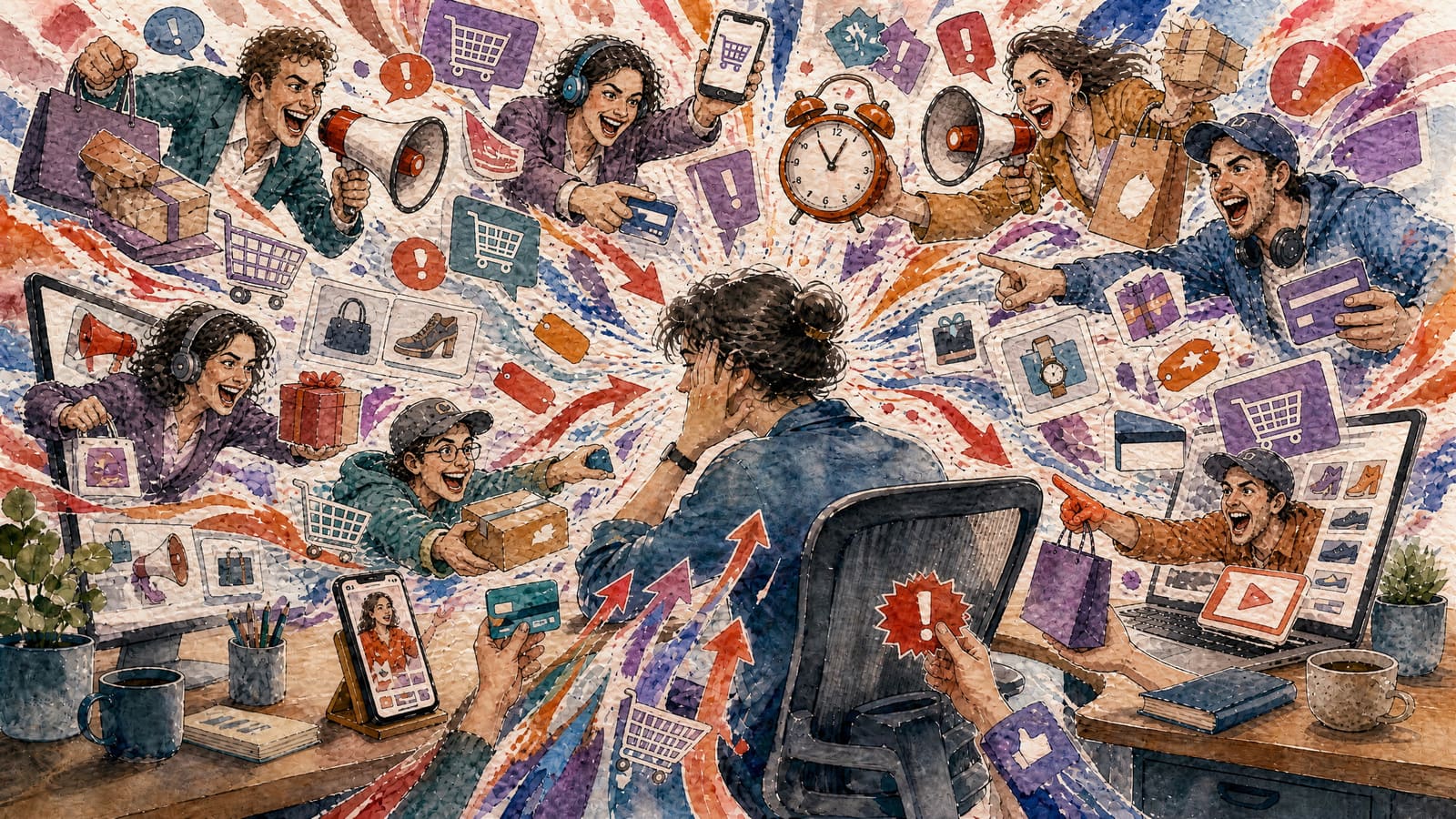
How many times a day does something take your attention without you ever asking for it? A popup in the middle of an article. An ad before a video you chose to watch. A push notification from an app you opened for something else entirely. None of them asked whether you wanted it — and none of them gave you anything in return.
Meanwhile, the companies trying to get into your head do pay. They pay Google, Facebook, billboard operators, YouTube channels. Just not you — the person the attention is actually taken from.
Why the market won't fix this on its own
You might expect the market to sort this out eventually. It won't, and there is a solid economic reason why: this is a negative externality — the same mechanism that governs pollution. A factory pays for production but not for the smog its neighbours breathe. An advertiser pays a platform for the impression but pays nothing for your fatigue, your distraction, or the time it costs you. That cost is carried by someone else entirely, who has no say in it.
And externalities, by their very nature, don't repair themselves through the market — which is exactly why pollution didn't go away until emission limits and outside regulation arrived. The same logic could be applied to attention.
What is already being tried
This isn't only theory. There are real precedents for where it could go:
- São Paulo banned all outdoor advertising in the city in 2007 — billboards, building wraps, advertising surfaces. A hard, blanket limit set by the city, not by the market.
- European television regulation has long capped how many minutes of advertising are allowed within a broadcast hour — nothing comparable exists for the internet, because digital "airtime" is effectively infinite.
- The European Digital Services Act, fully in force since 2024, bans advertising targeted at children, bans targeting based on sensitive data (health, sexual orientation, political views), and requires platforms to tell users why they are seeing a given ad.
- Platforms themselves already use frequency capping — limiting how often they show you the same ad. But they do it for the advertiser's efficiency, not for you: a saturated ad simply stops working.
So the infrastructure for measuring and limiting attention largely exists. It just serves the wrong purpose so far.
What a real cap could look like
Economics has several proven tools for this kind of problem — the same ones used for CO2 emissions:
A hard ban or quota. A fixed line nobody may cross (São Paulo, broadcast minutes). Simple and easy to enforce, but blunt — it makes no distinction between an ad that bothered the viewer and one that didn't.
A tax on extracted attention. Instead of a ban, every unit of extracted attention is taxed and the revenue returns as a public fund or directly to people — Andrew Yang proposed a version of this, the data dividend, in the US back in 2019. Several European countries now tax the advertising revenue of large digital platforms, though not yet by the amount of attention extracted. The upside: the market finds the efficient level itself. The downside: setting the "right" rate is hard.
Tradable quotas (cap-and-trade). It works for emissions, but attention isn't as interchangeable a unit as a tonne of CO2 — this model is probably the hardest to transfer.
Property rights over your own attention. Instead of a regulator setting the price from above, people get a clear property right to their attention and data and negotiate from below — collectively, perhaps, the way unions negotiate wages. GDPR gave people control (consent, access, deletion) but not compensation. That would be the next step.
One problem remains unsolved across all of these: how to objectively measure the price of a single view. CO2 has a physical unit. Attention doesn't — only imperfect proxies remain: impressions, estimated time on content, click-through rate. Regulation here will always be a compromise, never an exact figure.

What you can do about it
Until a cap arrives from outside, only one of them works reliably: the one you set yourself. Notifications off. An app opened when you want it, not when it calls you. Half an hour with no phone on you at all, because you deliberately left it in another room. None of that is self-denial — it is simply a decision about who you lend your attention to, and in exchange for what.
It sounds obvious, but it is worth saying out loud: nobody else is going to look after your interests. On the other side of the screen sit people who are paid for your attention, and the good ones know your weak spots better than you do — when you tend to be tired, what cheers you up, what you are afraid of, what hour of the night you will click on anything at all. It isn't a conspiracy, it's their job. Be most careful wherever something pushes at you with urgency, with shame, or with the fear of missing out — those are the three levers that work on almost everyone, which is exactly why they are used the most.
And it is worth noticing what we are actually defending. Attention isn't only a resource to be extracted — it is the material a life is made of. Whatever you give it to is what actually happens to you. A conversation you are fully present for stays with you for years; the one you half-had between notifications disappears as if it never took place. That is why this matters more than the number of minutes a day.
And one more thing I had to admit about myself: the ability to hold attention can be trained — and it can also be lost. Meditation and "mindfulness" are not esoterica to me, just ordinary practice of a single skill: noticing that something pulled me away, and coming back. A few minutes a day in silence, with no goal to achieve, does surprisingly much for how easily a popup catches me the next time.
What I can do about it
I'm not waiting for a directive to solve this. The websites I build are where I apply the principle right now: minimal trackers, no manipulative patterns in the interface, no advertising that pesters you simply because it can. If a website wants something from a visitor, it should give something clear and honest in return — not slip into their attention unnoticed and uninvited, then go hunting for their weak spots to make money from them.
And it isn't only a question of ethics. A website that respects a visitor's attention is usually a better website to use — and that shows up in the numbers in the end.